
David Bradley
Using your fingers to tweak your thinking
© 2021 Russ McNeil AhaUniversity.com

In normal situations, such a project would be allocated three to five years of development time. However, the current circumstances are anything but normal. Market pressure is intense. Lost revenue is flying out the window. They’re behind. Way behind. The competition has a head start and now the team is playing catch up. Only twelve months. Twelve engineers are given twelve months to do the impossible.
The year is 1981. 1 IBM is working feverishly to create a personal computer. A dozen engineers are hand-picked to create an electronic miracle. 1 Among the team members is David Bradley. 1 He doesn’t know it at the time, but he will soon earn his spot in the annals of computing history (for what seems like such a tiny little gesture).
As you develop new software or hardware (or in this case both), you encounter bugs and glitches. And lots of ‘em. Very often a continuous stream of them. You have to resolve each one, one at a time. It’s a tedious, time-consuming process, but you have no choice. It’s the only way forward.
Such is the situation for the IBM team. And every time they encounter a malfunction, they have to cycle power to get the system back to a non-glitch state. 1 And therein lies the rub, because every time they restart the system, it begins by performing a series of automatic tests. 1 These tests eat up valuable time. 1
If there’s one thing the team doesn’t have, it’s time. So, David decides to make a change. His adds a way to reset the system without performing the time-consuming tests. 1 The concept is simple: use a special keyboard sequence to initiate the fast reset. 1 The question is what combination to use? David chooses a combination of keys that would not likely be pressed by accident. 1 The combination he chooses only takes five minutes to program, and it’s still with us today 1. . .
ctl + alt + del
The story doesn’t end there, though. At that time, personal computers are still in their infancy. So are the operating systems they need to function. Microsoft Windows was still an entire decade away. So, when Bradley introduces his, now famous, keyboard sequence, it’s still a long way from mainstream. 1 Many consumers simply aren’t aware of it. Years later, Bradley is quoted as saying, “It [control-alt-delete] wasn’t intended as something we were going to tell the customers about.” 2 Nevertheless, word did get out.
Fast forward to the mid-90’s. The Windows 95 operating system takes off with widespread acceptance. Along with the attractive new look and feel though, comes something ugly, sinister, and blue—the dreaded “Blue Screen of Death” (BSOD). The BSOD raises its head when Widows encounters an unrecoverable error, which seems to occur entirely too often.
The Blue Screen of Death appears in epidemic proportions. All over the world Windows users fall victim to the blue plague. 1 Knowledge of the control-alt-delete “quick fix” spreads by word of mouth.1 “Suddenly, Bradley’s little code is a big deal. Journalists hail ‘the three-finger salute’ as a saving grace for PC owners […].” 1 Control-alt-delete also serves a second, very different, purpose in Windows. Users can use it to log out or to log in as a completely different person.
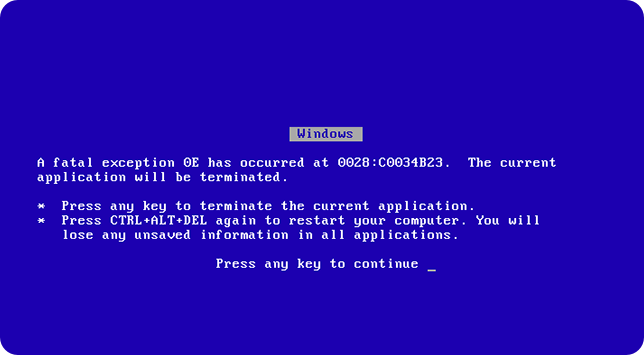
Fast forward one more time. The year is 2001. The venue: Museum of Innovation at San Jose Tech. The occasion: 20th anniversary of the IBM PC. After dinner, nine celebrity nerds, I mean technology luminaries, take the stage for a panel discussion. 1 Among them are Bill Gates and David Bradley. And to whom does the first question go? Not to Billy-boy. 1 The very first question goes to David Bradley. 1 The person wants to know whether he (Bradley) is the true inventor of the now famous keyboard sequence. Bradley’s response is classic. Poking fun at the pervasive Windows 95 Blue Screen of Death, he says, “I have to share the credit. I may have invented it, but I think Bill made it famous.” 3 The crowd roars in laughter. Billy-boy does not. 3
Control-alt-delete (cad) wields great power over the operation of a PC. It’s a special sequence that interrupts whatever the computer is working on. In essence, cad performs three functions. It rescues (by interrupting a serious error condition), it resets (by clearing corrupted code from memory), and it recasts (by allowing the user to start over with new credentials).
Turns out the control-alt-delete sequence does the same thing for people (for the ones who choose to employ it, that is). Cad can rescue a person by providing a way out of undesirable circumstances. It can reset by blanking the slate, starting fresh, if you will. And finally, cad helps us to recast, to cast ourselves as an entirely “new person.” With these parallels in mind, consider an alternate meaning of control-alt-delete:

Control your time, alter the way you think, delete negativity—daring steps that lead to mind-blowing life changes. In the words of the great western philosopher, Billy Bob Hayseed: “If ya keep doin’ the thangs you been doin’, yer gonna keep gittin’ more of what ya already got.” Translation:
If you want some things in your life to change, you have to change some things in your life
Change can be scary. Furthermore, genuine change takes commitment. The goal of this post is not to convince you to make changes in your life. The goal of this post is to explain why change can be good, and how to go about it, if you so choose.
Control your time
Time has a way of slipping away from us. The key is to be “productive” in what time we do have. This isn’t news. You don’t need an essay about all the reasons not to waste time. What you want is practical advice to help you make the most of your time. What follows is a list of actionable steps to maximize your time, things you can do. Test drive some the following (in no particular order) . . .
- Get started earlier in the day. This allows you to work when there are fewer distractions, or to extend the number of work hours in your day. (I prefer the first option.)
- Learn to say no; difficult for some people, necessary for all.
- Assess your commitments regularly; adjust where necessary
- Prioritize. Focus on what’s important. Keep in mind: urgent is not the same thing as important. Eliminate the non-essential.
- Plan ahead. I know it’s shocking, but some people actually do this.
- Get organized. Otherwise, you waste time “lookin’ for stuff” instead of actually “doin’ stuff.”
- Practice punctuality. This skill is worth learning because punctuality makes it easier to keep your schedule on track.
- Adopt the strategy of Time Blocking
This last point, time blocking, is so effective, so extraordinarily results-getting, it warrants a separate discussion of its own. But first, let us start by describing the most common scheduling method, which, is the exact opposite of time blocking . . .
Most people attempt to tackle their schedule with the “list/reactive” method. While this method seems logical, it is flawed from the get-go. Scott Young describes the list/reactive strategy as a casual approach in which,
“[…] you fill the time between scheduled meetings and calls reacting to emails and occasionally, when the mood hits you, trying to make progress on items plucked from an unwieldy task list.” 4
Any of this sound familiar? When you put it in those terms, it sounds downright chaotic, a bit like an octopus on roller skates. The challenge with this approach is that it allows other people to dictate your activities. 4 It’s hard to control your time if you spend most of the day reacting to whatever crashes into your schedule. There is a much better alternative. It’s called time blocking.
The purpose of time blocking is, in the words of Scott Young, “to give every minute a job.” 4 In this method of scheduling, you divide your day into blocks of time, where each block is dedicated to specific type of task. 4 For example . . .
08:00-09:00 Budget review
09:00-09:30 Check email
09:30-10:15 Zoom call with Dallas office
. . .
03:30-04:30 Draft quarterly report for CFO
Time blocking doesn’t prevent schedule disruptions. It does, however, provide a way to recover from disruptions. When you get knocked off your schedule, simply adjust the day’s remaining blocks of time. 4 “The key [to time blocking],” writes Young, “is maintaining intention about your time, not perfection in your planning.”
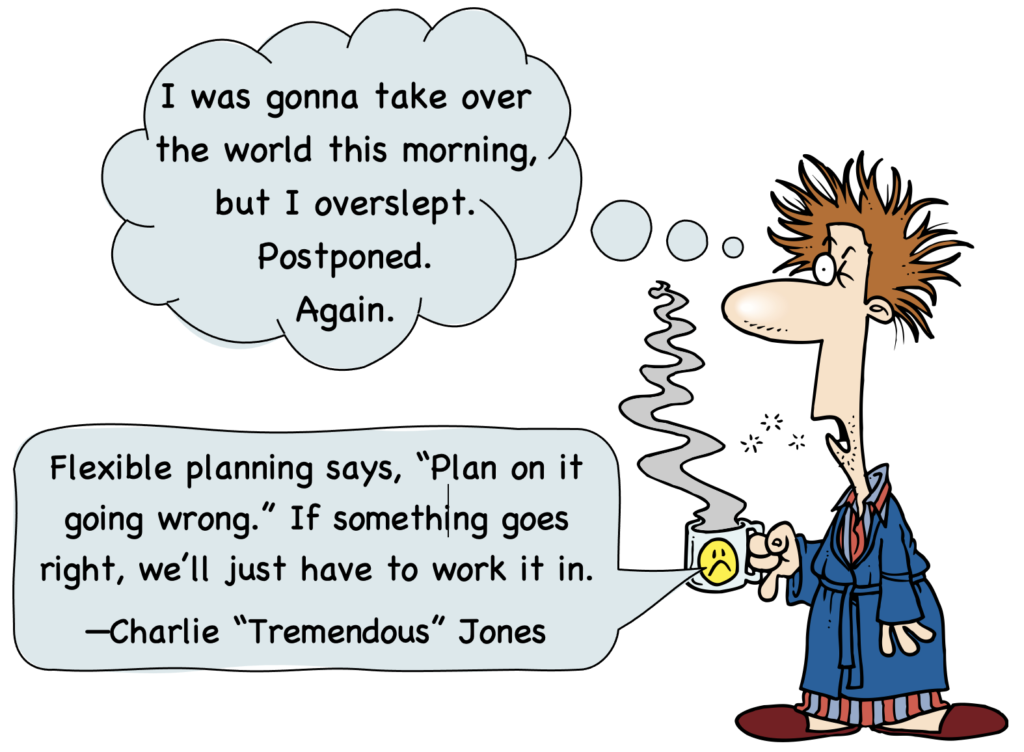
Clearly, not every work environment lends itself to the time block method, but many environments do. Whereas the example connotes a corporate environment, time blocking also works for many traditional business owners. The strategy is especially valuable for full-time networkers. Simple in concept, time blocking is profound in its effect.
Alter your mindset
Life is fraught with challenges. Any worthwhile endeavor is punctuated with struggles, disappointments, and frustrations. The question is not whether these things happen, but rather how we respond when they do. This is where your mindset plays a vital role. 5 The way you process adversity—particularly the way you respond to it internally—has a direct bearing on your future. The following tips can help to recalibrate your mindset for victory and triumph.
- Refuse to sweat the small stuff. Pick your battles. Stay focused on things that matter.
- Avoid comparing yourself to others. We all have different skills, talents, and natural abilities. It isn’t fair to compare your results to those of others. Nor does it serve any constructive purpose. In fact, it often has the opposite effect.
- Have a morning mental ritual. Examples: pray, meditate, read in a personal development book, listen to affirmations.
- Find a mentor. The benefits of a mentor are many. A proper mentor offers accountability, feedback, unbiased perspective, and problem solving, just to name a few.
- Treat failures as opportunities to learn. You can’t steer a parked car. Mistakes pinpoint areas in which we need to improve; they show us what we need to adjust in order to improve future results.
- Associations. Surround yourself with people who exhibit your desired mindset. How do they process their experiences? How do they adopt daily habits in order to mold their mindset? Now, do likewise.
- Get out of your comfort zone. Growth always involves stretching, pushing to new limits. Achieving something new, requires you to do something new. “New” is, by definition, uncharted territory. Of course, it’s uncomfortable. Embrace the discomfort. You’ll survive. Most likely.
- Embrace imperfections. We all have shortcomings. They’re a part of what make us unique. Set a high standard for yourself, but don’t crucify yourself when you or your results fall short.
- Stop seeking approval from others. Your value as a person is not determined by the opinions of other people. You have been “wonderfully made” by our Creator. You don’t need the approval of others. Furthermore, you waste time and energy when you seek it.
- Cultivate a sense of purpose. When you know what you’re going after, you gain much clarity. With this clarity, many of the points in this section will begin to fall in line.
- Emphasize growth over speed. We all travel a unique journey. Even when we share common goals, we follow different paths in pursuit of those goals. Some paths are short and direct, while others are long and winding. The question is nothow much time you spend on the path. The question is whether you develop into the person it takes to complete the journey.
- Affirmations. This is an entire subject unto itself. In my experience, affirmations are, by far, the most effective method of molding mindset. Why? Because they operate subconsciously. When correctly employed, affirmations affect your beliefs. Your beliefs drive your actions (or lack thereof). And your actions determine your results.

Delete negativity
Negativity is toxic. It takes a heavy toll on emotions, mindset, and even physical health. Negativity affects existing relationships and repels the formation of new ones. Moreover, it can prevent a person from achieving goals and attaining dreams.

Many negative people don’t recognize their own negativity. Do you often dwell on failure and difficulties? Do you see yourself as “stuck” and unable to improve your life, or even to move forward? Is it hard for you to believe you deserve to achieve your aspirations? If you’re answering yes, then you might want to consider addressing your negativity. The following tips help to do just that. In no particular order here are Eight A’s to the rescue . . .
- Abstain from a steady diet of bad news. Not everything we see, hear, or experience is going to be positive. Moreover, we can’t control all the information we take in. What we can do, though, is avoid taking in sources that constantly spew forth grief, woe, and destruction. Turning off mainstream media is a good place to start. (There’s a reason they call it programming.)
- Associate with positive people. It is human nature to model the people with whom we spend the most time. This process of conformity is so compelling, it’s virtually impossible to resist. If your goal is to become more positive, then make a point to spend the bulk of your time with positive people. (Hint: this may mean spending less time with specific people in your life.)
- Adopt an attitude of gratitude. Practicing gratitude increases contentment, satisfaction, optimism, joy, and enthusiasm. 6Furthermore, it reduces anxiety and depression. 6 An attitude of gratitude leaves little room for negativity.
- Acknowledge other people’s ideas. Some people are but-heads. These are the peeps who make a habit of responding to others with “Yeah, but . . .” The subject at hand makes little difference. But-heads always seem to find a negative angle, and they’re all too willing to express their negativity. Don’t be a but-head. If you have a legitimate objection, say, “Yes, and . . .” followed by your objection.
- Archive a list of personal successes. Keep a journal of major accomplishments, things you achieve, and goals you attain. Review the list periodically. This provides “evidence” for your cognitive mind to rebuke negative thoughts regarding what you can and cannot do.
- Assess the things other people say to you. Do not allow the opinions of others to dictate your worth or your abilities. Evaluate the things other people say to (and about you). Receive the positive. Reject the negative.
- Accept responsibility for your actions and mistakes. When you make excuses, you relinquish control to someone or something other than yourself. If your mistake affects another person negatively, and if you don’t make it right, you run the risk of damaging your relationship with that person. By accepting responsibility for your actions, you can improve your future results, and maintain healthy relationships.
- Arrest negative thoughts before they take root. The things you say to, and about, yourself are referred to as self-talk. When you engage in the same self-talk over and over, it forms a belief. Your beliefs dictate actions which, in turn, determine your results. Negative self-talk results in undesirable results; positive self-talk yields desirable results. If you find yourself exercising negative-self talk, arrest the thought and counter it with an opposite. The right affirmations, employed correctly, will eradicate negative self-talk.
Wrap-up
In 1981, a team of twelve engineers did the impossible. They produced a technological miracle in the span of twelve short months. Along the way, one man earned a spot in the computing hall of fame. David Bradley is his name. It’s a name few people recognize, and yet they utilize the man’s work nearly every time they log into a PC. Who’d-a-thunk it? A simple keyboard sequence—three keys, all with strange names—destined to leave their indelible mark on history.
Control-alt-delete, or as some like to call it, the “three-key salute,” is a tiny little gesture. Heck, it only took Bradley five minutes to implement. Nevertheless, the iconic sequence represents massive revenue for an equally massive corporation.
David Bradley never expected his “quick fix” to go public. But it did. And when Windows 95 came along with its ubiquitous Blue Screen of Death, ctl-alt-del proved to be indispensable to personal computers. Still today, we use CAD to rescue, reset, and recast.
The special sequence is also indispensable with respect to people. Controlling our time, altering our mindset, and deleting negativity—all prerequisites to maximizing our personal success. And here’s the thing: it makes no difference how you define success. Relationships, career, business, even athletics—all subject to the same three areas of performance: how we use our time, how we think, and our attitude.
Control-alt-delete offers people the same benefits as it does PCs. It rescues us from wasted time, misguided thoughts, and destructive attitudes. Control-alt-delete allows us to reset as necessary. Every day is a new day, a new opportunity to grow, to learn, to pick ourselves up, and to have another go at a worthwhile dream. Finally, Control-alt-delete allows us to recast ourself, to morph into an improved version of our former self. Work at it long enough, and you might not even recognize your old self.
And trust me, in my case, that’s something worth saluting.
Time is precious. Waste it wisely.
–RM
Note: This article covers a lot of territory. Some of the concepts warrant separate and thorough discussion. These concepts include saying no • arresting negative thoughts • affirmations • self-talk • your purpose • power of association •growth vs speed • reframing failures as successes. The Critter Lessons Series addresses these as well as many other subjects.
Regarding distribution of this article: You may freely distribute and/or post this article provided the following conditions are met: • it has not been modified in any way • title, references, bio, and this notice must be included • you realize no commercial gain from its distribution (including, but not limited to, affiliate programs and inclusion in other for-sale products) • you neither claim nor imply rights to any of the content herein.
Russ McNeil writes prolifically and trains for the Network-Marketing and direct sales professions. His content—endorsed by over 50 top-earners and experts—focuses on the art & science of human connection. Russ’s unique teaching approach uses traits and behaviors of animals as illustrations for communication, sales, & people skills. His trademark humor and unorthodox writing style appeal to readers on every continent except Antarctica (and if he ever manages to get an audience with one of those pesky penguins, he’ll probably stake a claim there too.) Discover more at AhaUniversity.com.
References
- Hughes, V. The History of CTRL + ALT + DELETE. MentalFloss.com. https://www.mentalfloss.com/article/51674/history-ctrl-alt-delete (2018).
- Aamidor, A. Thank this guy for ‘control-alt-delete.’ GannetOnline.com. http://www.gannettonline.com/e/trends/18001162.html (n.d.).
- Emails5com. Control-Alt-Delete: David Bradley and Bill Gates. https://www.youtube.com/watch?v=K_lg7w8gAXQ (2011).
- Young, S. Take Control of Your time. ScottHYoung.com. https://www.scotthyoung.com/blog/2020/08/29/take-control-of-your-time (2020).
- Arthur, K. Why Mindset Mastery Is Vital to Your Success. WordSmithRapport.com. https://www.entrepreneur.com/article/285466 (2017).
- Mager, D. The Benefits of Cultivating an Attitude of Gratitude. PsychologyToday.com. https://www.psychologytoday.com/us/blog/some-assembly-required/201411/the-benefits-cultivating-attitude-gratitude (2014).
If you refer to this article in your own work, please cite the source as: McNeil, R. Critter Lessons: David Bradley. https://www.AhaUniversity.com/blog/david-bradley (2021).