
Inspirational perspectives from an unlikely source
This post first appeared in the Critter Corner column of NetworkMarketingMagazine.com (July 2021).

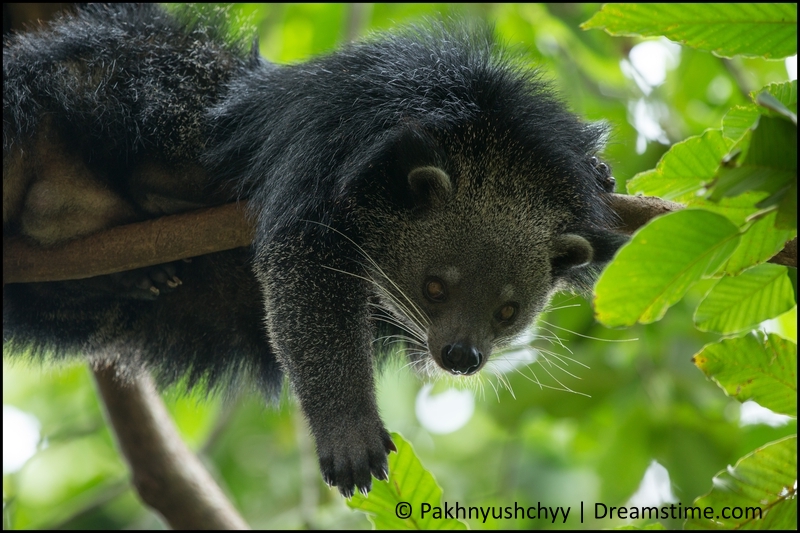
In the hot, steamy jungles of Southeast Asia, lives a most wonderful creature. 1 It’s about the size of a dog, dark gray to black in color, and dines primarily on fruit. 1 With the face of a cat and the body of a tiny bear, the furry little guy is often described as “adorable.” 2 The common name for this unusual animal is bearcat, but the proper name for it is binturong (bin’-tuh-wrong). 1,2
The binturong rarely descends to the ground, preferring instead to spend most of its time in the safety of the jungle canopy. 3 Like many mammals, the binturong marks its territory and attracts mates with a characteristic scent. This scent is delivered via a musk gland located on the bottom side of its tail. As the binturong moves among trees, its tail and musk gland drag along the branches. 3 This leaves behind an unusual fragrance.
Allow me to clarify. The binturong’s scent is unusual in the animal kingdom, but you’ve no doubt experienced it before, most likely in a movie theatre. The next time you sit down with a huge tub of fresh, buttered popcorn, and breathe in the delicious aroma thereof, you’re smellin’ the smell of binturong. That’s right, believe it or not, the scent of binturong smells exactly like buttered popcorn! 1,2,3
Who doesn’t enjoy an oversized bowl of hot, buttery popcorn? It’s a flavor with near universal appeal. So much so, one person even wrote a parable involving the fluffy white stuff. 4 Check it out:
Behold! At the time of harvest, ears of corn did bring forth kernels which were dried and prepared for the Popper’s hand.
And then it was that the Popper did take these kernels, all of which appeared alike unto him, and he did apply oil and heat. And it came to pass as the temperature of the oil increased, some kernels did explode with promise and did magnify themselves greatly, even to a hundred-fold. These kernels burst forth with whiteness, which both gladdened the eye and satisfied the taste of the Popper. Other kernels popped too, but to a lesser degree.
But lo, some kernels did just lie still and remain unchanged, and even though the Popper’s oil and heat was alike unto all, they did bask in the warmth of the oil and kept everything they had unto themselves.
And those kernels which had given of themselves did bring joy and delight to a great number of munchers. But those kernels that did keep the warmth for themselves and refused to burst forth, were fit only to be cast into a pail of refuse where they are regarded with hardness and with contempt.
And thus, we see how in the beginning, all kernels appear alike, but when the heat is on, some come forth and give their all, while others fail to pop and become as chaff only to be discarded and forgotten.
Oh, the lessons therein.
Despite the brevity of the popcorn parable, it contains multiple principles related to our profession. However, this commentary is supposed to be an article, not a treatise, or full-blown book, so let’s limit our discussion to only one of the lessons.
Popcorn Principle #1: Not all kernels are going to pop
Have you ever wondered why some popcorn kernels pop and others don’t? It’s one of the great mysteries of the universe. Correction: it used to be. But not anymore. In 2005, a certain team of researchers cracked the corn, I mean code. 5 It took no less than five chemists with a penchant for popping, but the mystery of popcorn is a mystery no more. We now know why some kernels blossom while others merely sit and do nothing.
It all comes down to what they’re made of.
Dried corn kernels have a tough outer shell. No surprise there. What’s not so obvious in what they have on the inside. For the purposes of our discussion, popcorn kernels contain two things on the inside: starch granules and water. 6
When you apply heat to popcorn kernels, the temperature of the internal moisture increases accordingly. Eventually, the water turns to steam. This steam, in turn, creates pressure inside the kernel. Initially, the outer shell is tough enough to withstand the pressure. 6 As the temperature continues to rise, so does the pressure. We can think of the kernel as a miniature pressure cooker cooking starch granules.
Somewhere north of 350 °F (180 °C), things really start to pop. 6 Literally. At this temperature, the pressure is somewhere around 135 pounds per square inch. 6 The outer shell can’t withstand this level of pressure, so the kernel ruptures causing the cooked starch to burst forth with a lip-smacking “pop!” 6
At least that’s how it works in healthy kernels. Research shows the number of kernels that fail to pop ranges from 4% to 47%, depending on the variety of corn involved. 6 So why don’t they all pop? Simple: the ones that don’t pop have inferior or flawed outer shells. These weaker shells are unable to withstand high pressures. 6 The water escapes before steam can form and before the starch cooks. 6 The result: no pop.
So, what does all this have to do with the networking profession? Turns out, quite a bit actually. Consider the following perspectives:
Perspective: Un-popped kernels get discarded
We’re not the in the business of “discarding” people. On the contrary, we recognize that everyone runs at a different pace so, we demonstrate patience with the peeps on our team. But—and a big but it is—quite a few people end up discarding themselves. That’s because this business is self-cleansing.
Everything we do in our business boils down to one single concept: attracting an army of volunteers. As volunteers, they are free to come and go at will. Volunteers don’t put up with foolishness. Treat them unfairly and away they go. And here’s the thing: they decide what is unfair, not you. Your intent is irrelevant. Their perception of your intent is all that matters. I’ve witnessed some pretty lame stuff in my my own uplines from the past.
One such upline was having good success; nice cash flow; momentum within the team; his future looked bright. Unfortunately, it went to his head. Without realizing it, he came across as arrogant. He had a genuinely good heart, but the signals he gave off relayed a seriously offensive vibe. How many people did he blow out? We’ll never know. A different upline put on an open display of pettiness. And the kicker is he was benefitting from what he imagined to be an offense! He did not make a good impression. I was brand new at the time. Had I been of a less determined temperament, I might well have quit.
Neither of those individuals lasted in the long run. That’s because our business is self-cleansing. Arrogance and pettiness are merely two examples among many. Dishonesty, insincerity, hypocrisy, tactlessness—character flaws have a way of ending networking careers.
The remedy is three-fold: self-awareness, apologies, and self-improvement. Evaluate your words and actions through the eyes of others. When you make a mistake, own it, apologize for it, and ask forgiveness for it. Then, finally, purpose to avoid the same mistake in the future. Personal development makes these possible.
Perspective: Un-popped kernels bring no joy
Occasionally, I offer to mentor a rep in the art and science of human connection. One of the most common issues I uncover in the process, is the issue of incongruent words.
Zig Ziglar famously said, “You can have everything in life you want, if you help enough other people get what they want.” We’ve all heard this before. Most of us have repeated it. We believe it too. How could we not? It’s a profound proverb positively radiating with Truth and wisdom. The question is not whether we believe it, but rather do we live by it? Are our actions and words congruent with the attitude of “others first”?
Think about the words you say when you engage prospects. Do you overuse the personal pronoun, “I”? I used to use the I-word all the time (“I’m working with a new company…”, “There’s this opportunity I’m excited about…”, “I’m wondering if you’d be interested …”). I really did want to help people, but my words weren’t congruent with my intent. Unfortunately, my words were a major part of what the prospects had to go on. The I-word, made it all too easy for prospects to misread my intent. The remedy for this dilemma was to reframe my words to include “you,” while, at the same time, omitting the word “I”. (A future lesson explains how.)
When our words say, “me-first” our intent makes little or no difference. People welcome our intent to bring value into their life, and it starts with them recognizing that intent. Our words make it possible. Our words can also make it impossible. When we use you-centric language, others welcome our message. When we use me-centric language, not so much.
The networking profession offers unparalleled opportunities to bring significant, lasting value into the lives of others. It’s one of the greatest attributes of the business. Indeed, it’s one of the biggest attractions of the business. If people knew the full spectrum of what we offer, we wouldn’t have to prospect them. We would sit back and interview them. We have a great story to tell. All we have to do is tell it often and tell it well. The alternative is what exactly? To remain unpopped? Not me, thank you very much. I choose to pop. I choose to bring delight.
Perspective: Some kernels make a conscious decision not to pop
Network-Marketing is not a welfare system. If ya wanna have, ya gotta do. In our profession, we get paid for one thing: results. In Burg and Mann’s excellent book, The Go-Giver, we learn the Law of Compensation: “your income is determined by how many people you serve and how well you serve them.” 8 If this is true—and it is—and, if so many networkers sincerely want to serve others, why then do so many of them quit?
Because they choose to. Personal growth is rarely comfortable. Learning new skills takes work. Sowing seed takes time. Why do so people many quit? Because they choose to avoid discomfort; they choose to avoid the necessary effort; they choose to be impatient. Or … they simply aren’t up to the rigors of a bona fide journey to success. Some kernels simply can’t withstand the heat. They vent their steam early on, leaving nothing left to pop and blossom.
According to the popcorn parable, the Popper took the kernels, “all of which appeared alike.” You can’t tell up front which team members will blossom, and which ones won’t. Network-Marketing 101: Don’t listen to what they say; watch what they do.
Emerson tells us, “Many people die with their music still in them.” In the same way, many kernels die with their starch still in the them. Our part is to be our best so we can attract as many of them as possible. And there aren’t many things more universally appealing than the aroma of a big ol’ bowl o’ warm, buttery popcorn.
Just ask the binturong. If it wasn’t for his appealing aroma, he would never reproduce duplicate at all.
–RM
References
- Alderton, D. Encyclopedia of Animals. (Amber Books, 2009).
- Bates, M. Binturongs: The Creature Feature: 10 Fun Facts About the Binturong (or, How Can It Binturong When It Feels So Right?) https://www.wired.com/2013/10/the-creature-feature-10-fun-facts-about-the-binturong-or-how-can-it-binturong-when-it-feels-so-right (2013).
- Swain, K. Binturongs: Pivotal Personalities in Rainforest Conservation. https://naturalscienceseducation.wordpress.com/2015/11/16/binturongs-pivotal-personalities-in-rainforest-conservation (2015).
- AngelicDreams4U. Popcorn Parable.https://angelicdreams4u.blogspot.com/2019/01/parable-of-popcorn.html (2015).
- Tandjung A. & Janaswamy, S. & Chandrasekaran, R. & Aboubacar, A. & Hamaker, B. Role of the pericarp cellulose matrix as a moisture barrier in microwaveable popcorn. Biomacromolecules 6, 1654-1660 (2005). DOI: 10.1021/bm049220l.
- Katakam, A. POP! The Science of Popcorn. https://chemclubchoate.wixsite.com/thechefslab/post/pop-the-science-of-popcorn (2018).
- Helmenstine, A. How Popcorn Pops. https://www.thoughtco.com/how-does-popcorn-pop-607429 (2019).
- Burg, B. & Mann J. The Go-Giver. (Portfolio, 2015).
If you refer to this article in your own work, please cite the source as:
McNeil, R. Critter Lessons: Popcorn in the Jungle. https://ahauniversity.com/blog/popcorn-in-the-jungle (2021).