
Isn’t it delicious? Golden advice from a platinum blonde.
In 1998, the American Film Institute nominates 400 movies as potential finalists in its list of the 100 greatest American movies. 1 Four years later, the AFI publishes a list of the 100 funniest American movies. 2 A certain movie showed up on both lists. The movie’s fame, however, has nothing to do with being great or funny.
The movie to which I refer stars that forever famous blonde, Marilyn Monroe. The platinum-haired beauty has a reputation for seducing box office sales, and on September 15, 1954, her powers of purr-suasion are in full force. For it is then Billy Wilder directs her in one of the most iconic scenes in movie history. 3
“Always Right.” So claims the smaller of two neon signs on the storefront. It’s a play on words. Displayed even more prominently, also in neon, is the name of the shop, Wright’s Food. 6 Today, 590 Lexington Avenue, Manhattan, is the home of Le Relais de Venise, a French restaurant, but in 1954, Wright’s it is. 4, 5 In the Big Apple, cafes come and go, but one thing at 590 Lexington remains the same. It’s something that was there in 1954 and it’s still there today.
The “it” is a metal grate. Subway systems require ventilation shafts. These shafts extend to up ground level where they are covered with metal gratings. You can hear trains passing underneath these grates. You can also feel air forced out of them by passing trains. The subway grate of interest is situated at 590 Lexington Avenue in Manhattan. No doubt countless pedestrians stroll across it every day, but how many of them realize when they walk on this particular grate, they trample history?
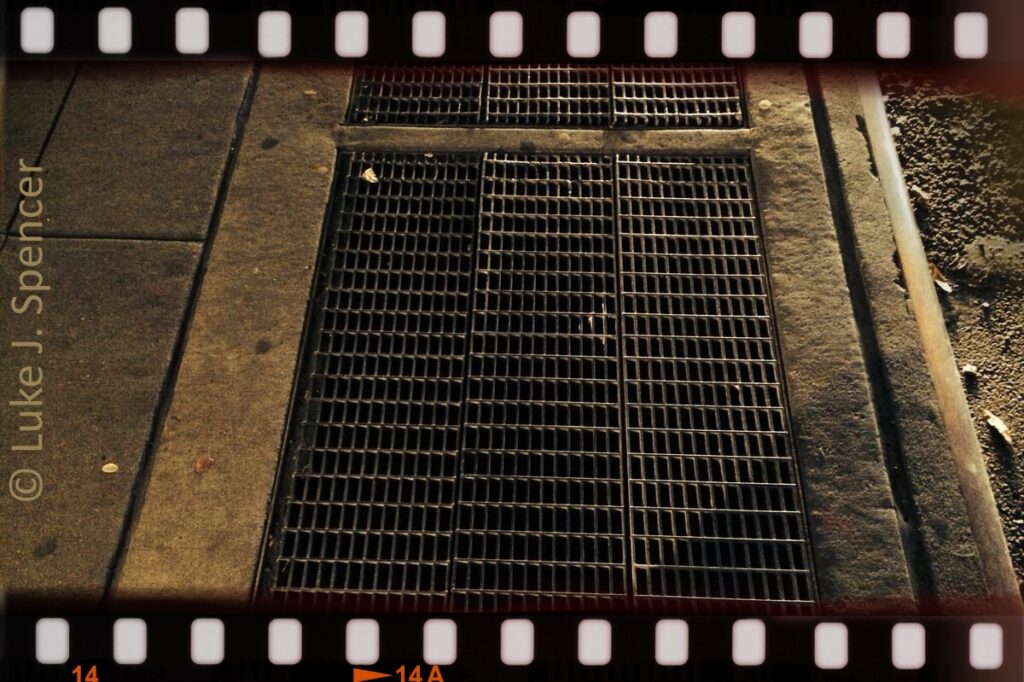
The iconic scene takes place during the filming of The Seven Year Itch. Marilyn Monroe and her co-star, Tom Ewell, stroll along the sidewalk. Upon hearing an approaching subway train, Marilyn steps—rather intentionally—onto the now famous subway grate. The passing train forces air from the vent, causing her white pleated dress to blow up “suggestively above her knees—and sometimes over her head.” 6 The actress makes a genuine effort to force her dress down, back into place, but this halfhearted attempt at modesty is negated by her next line: “Oooo . . . do you feel the breeze from the subway? Isn’t it delicious?”
The genesis of the scandalous dress scene takes us back an additional thirteen years. The year is 1941. 8 Sam Shaw, photographer, conducts a photo shoot for Friday magazine. 6 The shoot features a sailor and his girlfriend at Coney Island. 6 One of the photos shows the girl’s skirt blowing around due to a strong wind. 6 The photo makes the cover, and the magazine issue sells out immediately. 6 By the time 1954 rolls around, Sam and Marilyn are good friends. 6 It comes as no surprise Sam ends up as still photographer for the Seven Year Itch project.
So, Billy Wilder is directing a movie in which Marilyn Monroe stars. The movie contains at least one outrageous scene. Sam Shaw is on deck to capture “interesting” moments during production. Somewhere along the way, Sam recalls the photo shoot he did for Friday magazine, the one that generated so many sales. 6 The memory inspires an idea destined to make filmmaking history: Why not use the same concept to promote The Seven Year Itch? 6 Sam would capture just the right photo and it can be incorporated into promotional materials such as the official movie poster. 6
In order to avoid attracting a crowd, the subway scene is scheduled for 1:00am when the street is “fully deserted.” 9 Billy Wilder leaves specific instructions to keep the time and location under wraps. 9 He knows if word gets out, he’ll have to contend with hordes of onlookers during the shoot. 9 Word leaks out anyway—into newspapers, radio, and on television, most likely the handiwork of a publicist. 9 Despite the wee hour, fans swarm the shoot; somewhere in the range of 3,000-5,000. 10, 11
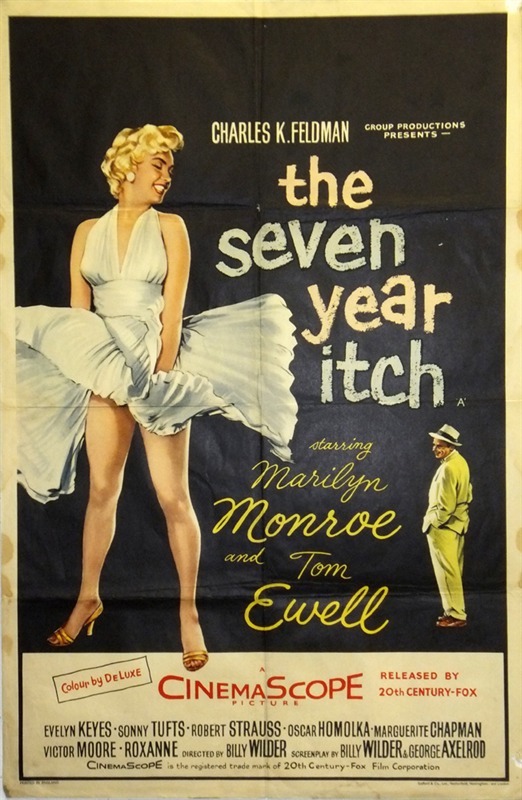
The passing subway trains don’t create enough updraft to create the desired effect so, remote-controlled fans are deployed beneath the grate. 5 After three hours and fourteen takes, the shoot is ended. 5, 11 The presence of the crowd and the overtly sexual nature of the footage make the effort unusable.11 Sam does get the photos he envisioned though. 20th Century Fox selects one of them—the most iconic of all—for use in the official movie poster. 6
Between movie posters and the press, Sam’s photo garners much attention. But, despite the brouhaha over the scene at 590 Lexington, that particular footage never actually makes it into the movie. 6, 11 The dress scene in the movie is filmed months later under controlled conditions in a Hollywood sound stage. 11 The two film takes are separated by more than mere physical distance. Whereas the first take captures Marilyn’s dress billowing over her head in a full body shot, the second shoot captures only her legs with the dress blowing barely above the knees. 11
All that worldwide attention, and to think, it all starts with a tease. Not just any tease mind you, but an extraordinarily well orchestrated one. The Seven Year Itch tease checks all the boxes.
The tease of interest starts with an attention-grabbing dress—glitzy rayon-acetate crepe; heavy enough to swing as the actress walks, and light enough to catch that famous breeze from down under; bias-cut, halter neck, accordion pleats, with a slim belt wound in a bow at the waist. 12 In order for something to grab attention it must stand out. Marilyn’s white dress certainly does that. William Travilla, designer of the dress, describes it as “a silly little dress … cool and clean, in a dirty, dirty city.” 12
An effective tease also requires proper timing. In this case, one o’clock in the morning, and being accidentally “leaked”, does just the trick. Words and body language also factor in. “… Isn’t it delicious?” speaks for itself, and as for body language . . . well . . . fill that part in for yourself. And finally, an effective tease holds back on the detail. The final dress scene barely shows Marilyn’s knees.
It’s a contrived tease to be sure, but it certainly has the desired effect.
John David Mann wrote a delightful little foreword to my first book. In it, he likens prospecting encounters to scenes from a movie. It doesn’t involve a subway draft or a sultry dress, but it sure is revealing to read about the similarities (between prospecting encounters and movie scenes, that is). Turns out, Marilyn Monroe has it pretty well figured out.
We all are in sales. And I do mean all. (If you have any doubts, More Critters, More Lessons presents the proof.) One thing is for sure: a certain platinum blonde is very aware of her career in sales. She has movies to promote and an image to sell. And sell, she does!
I have never worked a day in my life without selling. If I believe in something, I sell it, and I sell it hard. —Estee Lauder
Not everyone is endowed with the (ahem) “skills” of Marilyn Monroe, but we can sure follow a pattern that gets results. If there’s one thing the bodacious blonde bombshell knows, it’s how to get results. When it comes to prospecting for MLM, the story of the subway/dress scene illustrates several important truths; seven of ‘em to be precise. Think of them as the “Seven Sales Secrets of a Sultry Subway Scene.” Note: What follows is merely an overview. The ins and outs and step-by-step how-tos are addressed in other portions of my content.
Attention, please! (1 of 7)
We live in a world of distractions. The hustle and bustle of everyday life has a way of keeping us busy. We’re not always productive, but we always seem to be busy. If we aren’t careful, we get so focused on the routine stuff, we don’t notice even better stuff when it comes along. Now, consider this: what’s true about you is also true about your prospects. Many of them are bumping through life with their head down, and there you come be-bopping along with an amazing opportunity, and no one seems to notice. Sound familiar? What you need is a way to grab their attention. Clearly, Marilyn knew how to capture attention. Her strategies don’t work so well for me, but here are some alternative ideas that do work well for me.
- Make a humorous observation–Good humor is profoundly effective at opening conversation and creating human connections. Occasionally, I cross paths with someone wearing a Bluetooth earpiece. They wear it so much they forget they have it on. I might look at them with a straight face, point at the earpiece, and say, “You know, . . . I know a doctor who can remove that growth on your ear.” They chuckle. I chuckle. I have their attention.
- Unexpected wit–What do you say when someone greets you with, “How’s it going?” Most people respond with “Pretty good” or “Fine” or some other ordinary reply. Ordinary doesn’t cut the mustard. If you want to grab attention, respond with something out of the ordinary. I have several snappy responses. My current favorite is, “I’ll tell you what. If I was doin’ any better, I’d have to charge admission just to say, ‘Hi.’” It’s unexpected. It’s positive. I have their attention.
- Offer a compliment. Genuine compliments are always welcome. They break through the mundane. They overcome negativity. They make you stand out. Give someone a sincere compliment, and you are guaranteed to have their attention. Take time to learn about types compliments, how to give them, and how to compliment peeps of the opposite gender with class. Then watch your business explode.
Strategies like these open the door to new relationships. So, whether you’re prospecting. or you just want to get better at connecting with people, it pays to know how to capture a person’s attention.
Let’s have a moment of silence for all those people who are dying for attention.
Say what? (2 of 7)
Having a person’s attention is not enough. You must also have something worthwhile to say. Think about Marilyn’s lines in the famous scene: “Oooo . . . do you feel the breeze from the subway? Isn’t it delicious?” She did a lot of communicating with those two lines. It’s probably not the same message you’re trying to convey to your prospects, but you have to admit she definitely got her message across.
Your message may be different, but the strategies remain the same. That which you say should be (1) minimal, (2) positive, (3) focused on the other person, and (4) phrased in the form of questions. Avoid dominating the conversation. Edify and uplift; never gossip or tear down. Make it about them, not you. Demonstrate genuine curiosity by asking questions rather than making statements. The patterns of conversation outlined in the critter books address these simply and automatically.
One final word about verbal communication: A popular myth would have us believe that only 7% of our communication is conveyed via words. Don’t buy it! It’s not even remotely true. The myth is a gross distortion of scientific research. It simply does not to apply normal conversation. Even the original researcher agrees. Not convinced? Feel free to email me for unequivocal proof.
Keep on keepin’ on (3 of 7)
Any worthwhile endeavor is going to come with its share of challenges. The bigger the dream, the bigger the struggle. The question is not whether we’re going to be tested, but rather how we respond to tests when they do arise.
Marilyn Monroe was notoriously forgetful of her lines, at times requiring up to 40 takes in order to get them right. 10, 14Some people find this a reason to criticize her. I have a very different perspective. Think about it—surrounded by cameras, all eyes on you, getting barked at by some rude director, and you forget your lines; not once, not ten times; not thirty times; but forty times. In a row. I say she should be commended for her persistence.
Do you have big goals? You’re gonna need a big dose of persistence to go with ‘em. You might remember your lines, but what if other people forget theirs? You know—like when they forget to say YES, and tell you NO instead? What if team members forget about their dreams and quit? What if ten or twenty in a row do that? I’ve had it happen you know. Would that bolster your resolve, or buck you out of the race? In our profession, persistence is not merely an advantage. It’s an absolute must.
It’s all about timing (4 of 7)
Timing is a recurring theme in life, and it plays a key role in many of our day-to-day activities. Proper timing works to our advantage whereas poor timing, not so much.
Take, for instance, the role of timing in the filming of the famous subway/dress scene. Takes had to be timed with the passing of a subway train. Billy Wilder could shout, “Action!” at any time, but it wouldn’t achieve the desired result without the presence of a passing subway train.
In the same way, the offers you make to prospects are subject to a kind of timing. Your offer, as good as it is, only makes sense if your prospect is at a point in life to explore opportunities. When you reach out to someone, be it on- or offline, you probably have little knowledge of the things going on in their life. A pending childbirth, marital separation, a recent job change—any significant life event, even a positive one, can mean “bad timing” for your prospect. This is merely one way in which timing affects your business. There are others.
Leave a lasting positive impression (5 of 7)
Clearly, Marilyn knew how to make an impression. She also knew how to leave a lasting impression. Otherwise, there would be no subway/dress scene after all this time for us to discuss.
Lasting impressions are equally powerful in our business; perhaps even more so. Maya Angelou writes, “People will forget what you said, people will forget what you did, but people will never forget how you made them feel.” So true. Words we should all take to heart; especially those of us engaged in Network Marketing.
Nearly everything we do in our business boils down to one central theme: building an army of volunteers. We prospect people, some of whom join us voluntarily. If they plug into upline and the team system, they do so voluntarily. If they commit to personal development, they do voluntarily. If they stick around for the long term, they do so voluntarily.
If you want to attract and retain volunteers, you must engage them in ways they perceive as fair, fun, and rewarding. It starts from the very first encounter with the words you use. Your words have, within them, the power to affect the feelings of the people you engage. They will never forget the way you make them feel. Lift others up; give ‘em a reason to laugh; listen to what they have to say; and leave a wake of positive emotions. In so doing, you create a trail of positive lasting impressions that lead to the next step.
Do enough of these things and peeps will practically line up to volunteer.

Employ the “detail tease” (6 of 7)
Among the crowd attending the subway/dress film shoot are 200-300 photographers. 9 And trust me, they aren’t there to snap train photos. The star of the show is the buxom blonde of the silver screen. The camera loves Marilyn. 14 So, the question isn’t whether the photos taken will be appealing, but rather just how appealing will they be. Or, perhaps more accurately, how revealing they will be.
Bear in mind, the year is 1954. The moral standards are very different seven decades in the past. The mere theme of the movie (adultery) is on the Motion Picture Production Code list of no-nos. (The Seven Year Itch poses the plot as a dream, allowing it to squeak by.) A shot of Marilyn’s dress billowing above her head isn’t about to make the final cut. However, moral standards in America are shifting in 1954. So, while on one hand the scene violates the standard of decency, on the other, it captures the imagination of the public.
The final cut includes only the actress’s legs with the dress rising to just above knee-level. It’s too late though. The publicity shoot, complete with extra fans and 5,000 onlookers, already let the cat out of the bag, so to speak. By the time the movie is released, people flock to theaters. It’s easy to imagine what they’re thinking . . . If the commercial is that “good,” I can’t wait to see the entire film.
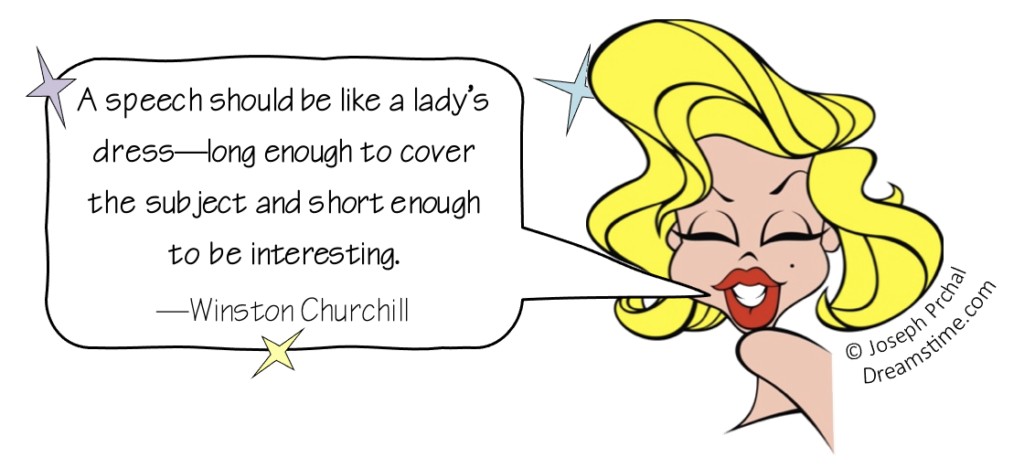
And there you have it: an enormous lesson for networkers: a well-executed tease encourages your audience to seek more information. It’s a classic case of “less is more.” Sharing too much detail early on is a common mistake among lesser experienced networkers. Churchill was spot on—“… and short enough to be interesting.”
A solid MLM opportunity is a magnificent thing to behold. It represents significant income potential. It also represents much more than monetary compensation. A wholesome opportunity has within it the capacity to impact others in a multitude of profoundly positive ways.
If.
If the prospecting encounter isn’t wasted due to an avoidable blunder. Like sharing too much detail. It matters not whether you approach your prospect online or offline. If you attempt to explain your comp plan yourself, you are selling your opportunity short. Here’s why: it isn’t possible to explain enough in the initial encounter for the prospect to decide to join you then and there on the spot. (Technically, it is possible, but very, very few people have the skills to pull it off. And even if you are one of those rare individuals, it isn’t duplicable.)
The better approach is to avoid detail in the initial encounter, to whet their appetite for more information; ideally information that doesn’t come in the form of you talking. The specific strategy varies from team to team, but most teams use video links, phone apps, or Zoom calls to explain the opportunity (and product). This approach removes you from the presentation in favor of a professional presentation. This approach is perfectly duplicable, because it means you don’t need special presentation skills. Even more important, the peeps you sponsor don’t need them either.
The truth is, during the initial encounter, your prospects don’t need to know what it is you’re doing. They question is not whether they want to do what you’re doing. (If that was the question, they would have to know details about what you’re doing.) At the time of the initial encounter, the only question that really matters is, whether they are at a point in life to explore other options. This a very different question, and they don’t need any information to answer it. In the Critter Lessons this question is referred to as a Magic Question. This notion may seem odd a first, but don’t knock it till you try it.
You shall know the truth, and it will make you odd. —Flannery O’Connor
Here’s a great Magic Question. It has served me well, and it will do the same for you: “Are you at a point in life to explore outside opportunities, I mean, if they don’t take too much time?”
Eliminate the detail. Employ the tease. Enjoy the results.
. . . all without violating a standard of decency.
Be humble (7 of 7)
C.S. Lewis writes, “Humility is not thinking less of yourself. It’s thinking of yourself less.” The name Marilyn Monroe, and the word “humility” don’t normally appear in the same sentence. Playing to the camera in the manner for which she is so famous . . . well . . . humility just doesn’t seem to fit the picture. However, there is still a case to be made. It should come as no surprise that this case involves The Seven Year Itch.
If you were to read the credits for the movie, and in so doing, if you pay special attention the character names, you might notice something unusual. The character played by Marilyn has no name! The credits refer to her as simply, “The Girl.” One of the most popular actresses of her time, and the role she plays isn’t even given a name.
Okay, I admit this isn’t a reflection of Marilyn’s personal humility (or lack thereof). But then again, this lesson is based upon metaphors, and as metaphors go, the no-name girl is an excellent stand-in for the virtue of humility.
In our narrative of the subway/dress scene, humility exists only as a metaphor. In the real world, however, when you interact with real people, genuine humility is a very real concept indeed. And when you employ it, you set the stage for rewarding win-win situations.
When it’s done properly, team-building focuses on others rather than self. Humility is a powerful way to exhibit an “others first” mindset. There’s always the obvious demonstration of humility such as squelching the word “I” from your conversations and choosing words that emphasize the interests of others. But genuine humility runs much deeper.
Help others to recognize their talents, to set goals, to develop their strengths, and to expand their vision. Encourage others take on new challenges and to overcome their fears. Measures like these are ways to put the interests of others above your own. And if you’re building a network team, they come with a bonus: Every last one of them contributes to your business as well as to those of the other individuals.
Wrap-up
In 1954, a certain photograph set off a sizzling spark of publicity. All these years later, and that spark still burns as brightly as ever. The iconic image of an alluring actress, posing provocatively, challenging the status quo, of course it captured much attention. That famous dazzling white dress fanned the flames even more. The fabric, the cut, the swing, the style—all designed to leave a lasting impression.
It starts with a sound—the rushing of a subway train—followed by the sudden updraft of air and the billowing parachute of a shimmering skirt. And still, the tease is not complete. Not until the actress utters those perfectly timed, seductive, beguiling lines, “Oooo […] Isn’t it delicious?” Who said, “Words aren’t important?” Whoever they are, they need to stop blowing hot air, get out more; take in a classic movie or two. Then tell me good dialog isn’t important.
Great lines don’t always come easy, though. It takes practice to get ‘em right. In some cases, lots of practice. That’s why persistence is key. Ya gotta keep at it in order to master the art.
The networking profession is unlike any other kind of business. We use professional strategies to capture attention, after which we attempt to ignite a spark of interest. We employ wholesome principles to create positive lasting impressions. We tease with empathy, and we chose our words carefully because words affect people in profound ways. We look for people with an “itch” and offer a product or opportunity as a potential “scratch.” We do all this over and over because only through persistence can the novice become the master artist.
And even after we perfect the art, there’s work to be done. The final noble effort comes in the form of practicing humility. For it is humility that empowers us to touch the most people in the most profound ways. And ultimately, that is the foundation upon which our business is built.
Mmm, mmm. Isn’t it delicious?
Note: This overview article touches briefly on several subjects vital to success in prospecting. Capturing attention • Developing persistence • Words: the importance of and which ones to use • Questions (the power of and what to ask) • Humility vs confidence (and how to signal them) •When to share details and when not to • Making positive and lasting impressions • Six types of timing and the roles they play in your business. The Critter Lessons Series explains how to do of all these with respect and integrity. And those merely starters.
–RM
References
- Dirks, T. America’s 100 Greatest Movies: The 400 Nominees. FilmSite.org. https://www.filmsite.org/afi400films.html (n.d.).
- American Film Institute. The 100 Funniest American Movies of All Time. AFI.com. https://www.afi.com/afis-100-years-100-laughs (n.d.).
- Donahue, A. ‘That silly little dress’: the story behind Marilyn Monroe’s iconic scene. TheGuardian.com. https://www.theguardian.com/film/filmblog/2014/sep/15/marilyn-monroe-seven-year-itch-dress (2014).
- Spencer, L. Marilyn Monroe’s Subway Grate. AtlasObscura.com. https://www.atlasobscura.com/places/marilyn-monroe-s-subway-grate (n.d.).
- Coneybeare, M. Here’s Where You Can Find Marilyn Monroe’s Iconic Subway Grate in Midtown Manhattan. Viewing.NYC. https://viewing.nyc/heres-where-you-can-find-marilyn-monroes-iconic-subway-grate-in-midtown-manhattan (2016).
- Stevens, M. Behind-the-Scenes of Marilyn Monroe’s Iconic Flying Skirt (PHOTOS). Biography.com. https://www.biography.com/news/marilyn-monroe-seven-year-itch-dress-photos (2014).
- Meyers, S. Conversations with Billy Wilder & I.A.L. Diamond [Part 8]. GoIntoTheStory.Blcklst.com. https://gointothestory.blcklst.com/conversations-with-billy-wilder-i-a-l-diamond-part-8-fd0ce3968734 (2011).
- Cristelle. Shaw Sam. CirsumPerificio.net. http://www.cursumperficio.net/FicheAS16.html (2006).
- Martin, P. The New Marilyn Monroe. Saturday Evening Post, May 12, 1956. http://www.marilynmonroe.ca/camera/mags/2post56.htm (n.d.).
- IMDB. The Seven Year Itch: Trivia. IMDB.com. https://www.imdb.com/title/tt0048605/trivia?ref_=tt_trv_trv (n.d.).
- Pastor, M. The Making of an Icon. viaUPhotography.com. https://www.viauphotography.com/blog/the-making-of-an-icon (n.d.).
- Lack, H. Remember when Marilyn Monroe’s white cocktail dress made movie history? Cnn.com. https://www.cnn.com/style/article/marilyn-monroe-white-dress-remember-when/index.html (2020).
- Barris, G. Marilyn: In Her Own Words (Citadel Press: 2001).
- King, S. Marilyn Monroe: People who knew her recall the real person. LATimes.com. https://www.latimes.com/entertainment/movies/la-xpm-2012-aug-04-la-et-mn-marilyn-monroe-memories-20120804-story.html (2012).
Regarding distribution of this article: You may freely distribute and/or post this article provided the following conditions are met: • it has not been modified in any way • title, references, bio, and this notice must be included • you realize no commercial gain from its distribution (including, but not limited to, affiliate programs and inclusion in other for-sale products) • you neither claim nor imply rights to any of the content herein.
If you refer to this article in your own work, please cite the source as:
McNeil, R. Celebrity Prospecting: Marilyn Monroe. https://www.AhaUniversity.com/blog/marilyn-monroe (2021).