
Dear Reader:
This page is best read in context, which means reading it after part 1 of my story. If you haven’t yet read part 1, I urge you to start here.
What you are about to read is an important part of my story, but it isn’t about me. It’s about the God of the Bible and His purpose behind the books that have my name on the covers. I’m not writing this to be in the limelight. I’m writing it to give glory to God because He is worthy of all glory.
One final note: several individuals played key roles in this part of my story. I go out of my way to withhold their names. I have no intention of disclosing the MLM company involved. Dropping certain names would practically spell it out. Some readers may figure it out anyway, but it won’t be because I made it obvious.
Chapter 1: Flare Prayer
It’s been two days since that fateful lunch with my mentor, Don. That was when he coerced asked me to train his Dallas team on the subject of “situational prospecting.” (Situational prospecting is the process of transforming every day, random encounters into mutually beneficial prospecting conversations.) To that end, I set out to create a slide presentation; target duration: 45 minutes.
This was years ago, but I still remember it vividly. I sit down to my computer and bring up PowerPoint. I lean back, staring at the first slide. It is stark white, utterly void, and lonely to the point of despair. After a minute or so (which felt more like an eternity), I grabbed my phone and speed-dialed Don.
“Hey, buddy. What’re ya up to?” he asks.
“I’ve got a challenge, Don.”
“Okay, let’s have it.”
“Well, I sat down to work on that PowerPoint presentation you asked for.”
“Okay . . .?”
“The thing is, I don’t have a clue what I do when I prospect.”
Don laughs. “Of course, you don’t. That’s why I asked you to teach it.”
“No, Don. You want someone who does know what they do when they prospect.”
“Au contraire, my friend. I want someone who doesn’t know what they do.”
“What am I missing here?”
And that’s when he introduces me to the Conscious-Competence Learning Matrix. I cover the matrix in one of the critter lessons, but for sake of story, here’s what Don was getting at: my prospecting skills are so finely honed, I operate on automatic pilot. I don’t even have to think about it. For me, prospecting just flows; naturally and automatically.
Don continues: “Here’s what you need to understand, Russ: you’re so good at situational prospecting, you’re not even aware of all the things you do and say to get such great results. That’s why I want you to be the one to teach it.”
And that’s also why I find myself back at my computer, once again staring at that lonely, stark white, slide.
Now, I know why I was drawing a blank, but I still don’t know what to type. Time to “pull out the big guns.” Which, in this case, means sending up a flare prayer…
“Lord, You put this stuff in me, and You’re gonna have to be the One to pull it out.” Immediately, the Lord started giving me things to write. More specifically, He gave me the names of eight key principles. He created me with an off-beat sense of humor, and the names of the principles reflect that brand of humor. Eventually, the names He gives me that night, become chapter titles in my first book.
That night, Our Heavenly Father opens my understanding into the art and science of prospecting. This new understanding takes the form of eight key principles. Many of the critter lessons relate, in some way, to one or more aspects of these principles.
You would think, given this experience, I would realize something special is unfolding. Nope. Oh, I recognize the special nature of the experience, alright, but in no way do I recognize the experience as a clue of things to come.
That realization doesn’t come until much later.
The slide show comes together rather nicely, even if I do say so myself. It’s a local audience, and a small stage, but none of that matters. I’m still nervous. Until, I get started, that is. Almost right away I see heads nodding, pens writing, and people are laughing at all the right times. In no time at all, the content starts pouring out, much in the same way a fire hydrant “pours.” It’s more like a tidal wave.
Chapter 2: I are so smart
Afterwards, people rush forward, notepads in hand, barraging me with questions. “How do you do this?” and “What do you say when the prospect does such and such?” I think, My soul! Nobody knows this stuff! I’m not sure why this fact is such a revelation to me, but it is.
Around this same timeframe, I’m reading a wonderful little book, by Dean Lindsay. Dean too lives in the North Dallas area. I have a chance to meet him and to purchase his book (which is, by the way, on my recommended reading list). I’m still enjoying Dean’s book the following week when I find myself at yet another national convention.
And that’s precisely where I am—sitting in the convention center in the middle of heartland, USA, when it happens.
It’s such a stupendous idea! Surely, it’s one of “my” best ideas ever. I’m so pleased with myself. When I get back home, I’ll sit down with Dean Lindsay and suggest that he and I collaborate on a book about prospecting. He’s a sales guy. He’s personable. I like his humorous writing style. And most importantly of all: he self-published his own book. It’s the perfect storm! Aren’t I just so smart?
In case you haven’t figured it out yet, the idea isn’t “my” idea at all. Our Heavenly Father planted the idea in my mind. The only thing is, I don’t realize it. Not yet anyway.
I’ll learn soon enough though. The Lord is getting ready to thump me on the head . . .
Chapter 3: Nothin’ left to it, ‘cept to do it
I return home. The vision of collaborating on a book with Dean Lindsay becomes clearer with each passing day. I’ve only met him the one time, but that ain’t no big deal for an ol’ prospecting cowboy like myself. His phone number is printed right there on the copyright page. That’s all the invitation I need. So, I pick up the phone and make the call.
“Hello, this is Dean.”
“Hey Dean. This is Russ McNeil. You may or may not remember me, but we met a couple of weeks ago at a networking event, in Frisco, at the Jason’s Deli. You and I chatted briefly after you spoke to our group—” I pause, expecting him to remember our encounter.
“Sure, I remember. How’s it going, Russ?”
“It’s going really well as a matter of fact. Listen, I have an idea for a project we might be able to collaborate on. I thought as long as you’re not opposed to stepping out of the box, we could get together for half a cup of coffee and see if it goes anywhere.”
“Yeah, we can do that. Let me grab my calendar.” (Notice he didn’t ask for detail. Hint to would-be master prospectors: Go-getters don’t ask a lot of questions, at least not initially.)
We pick a time later in the week. To keep things simple, we agree to meet the same place we met the first time. Two days later, Dean and I both arrive five minutes early. Another five minutes after that, and we’re settled and ready to get down to business.
“I know you’re busy, Dean. I appreciate you carving out some time to meet. I want to make sure I honor your time, so with your permission, I’m going to get right down to it . . .”
“Absolutely. Go for it.”
“Bottom line: I love your book. And, having read it, I believe there is an opportunity for you and me to collaborate on another one.”
“And what would this other book be about?”
I explain the concept of “situational prospecting.” I go on to describe why I feel qualified to teach on the subject, the similarities of our communication styles, and the synergy of our respective skill sets.
He nods in agreement and listens politely through my entire pitch (and make no mistake, I was definitely pitching).
I come to a gentle stop and prompt him with, “Your thoughts?”
“Well, Russ, you certainly make a strong case. I see plenty of synergy. Here’s what else I see: passion. You light up when you talk about prospecting. Whether you realize it yet or not, you have uncovered one of your passions. So, here’s my response to your idea: I’m honored that you would ask, however, God put that book idea in your heart, and you need to be the one to put it on paper.”
Then he continues with, “Publishing my own book taught me a ton about the publishing industry. Traditional publishers are uniquely positioned to take ruthless advantage of new authors. I will be happy to guide you through the minefield. I’ll mentor you through the process if you want, but the book itself is your responsibility. You should probably start on it right away.”
The Lord uses Dean’s words to thump me on the head. Finally, I realize the book is not my idea at all.
That night I start on the outline for what is destined to be my first book.
Chapter 4: So much bigger . . .
I know absolutely nothing about writing a book, so I approach it the only way I can think of—the same I would a software project. Afterall, they’re both abstract problems requiring concrete solutions.
Few things are more abstract than a conversation with someone you don’t know. The possibilities are endless, seemingly random. And yet, when it comes to situational prospecting, you don’t want a random outcome. Your prospecting conversations come with a very specific goal: to approach a person with your offer (most likely your business opportunity). In other words, situational prospecting involves moving from the abstract (spontaneous conversation) to the concrete (attaining your goal of making an offer). I promise not to nerd-out on you, so trust me when I say this is very much like developing software; taking an abstract idea and creating a concrete implementation.
When I begin to think of prospecting conversations as abstract-to-concrete problems, light bulbs start flashing everywhere. Turns out, my software development skills are precisely what I need to write the book. It’s almost as if “someone” had charted out my path from software engineering to MLM to prospecting struggles and on to book writing. Let me assure you there is no “as if” to it. No question about it. The God of the Bible, Yahweh, has been orchestrating the entire thing. At the time, I still don’t fully comprehend the degree of His involvement. Not yet, anyway.
The more I add to the manuscript, the more I realize needs to be said. Remember back in Chapter 1 when Don explains how I prospect unconsciously? Well, that’s all well and good in practice, but when I go to write about it, I need to be very conscious of what I do. If I don’t know what I do, I can’t very well write about it. That makes sense, doesn’t it?
Writing out the process forces me to peel back the covers, so to speak; to analyze every tiny detail of what I do and why it works. The more I begin to understand, the more I see that warrants explanation. I keep discovering “holes” in the book, things that require me to go back and insert new chapters. This is a time-consuming process. I don’t mind. In fact, I rather enjoy it. The writing is easy. It’s the thinking through it that takes so much time.
Somewhere along the way, I notice something interesting. I begin to feel a compulsion to develop the book. It’s as if the book is screaming to get out. It’s hard to articulate, but I know I have to keep going, to get the content out to the world. I couldn’t stop if I wanted to.
And still, I don’t connect the dots. I still don’t understand the Lord’s interest in the project. Not until about a year and a half into the manuscript. (The first book eventually takes 3 years to complete, so the event I’m about to describe takes place somewhere around the mid-point.)
I’m an active member in a business networking group. We meet once a week to learn more about each other’s businesses and to bring referrals to one another. One day, another member, an attorney, refers me to her mother. The attorney believes her mother will benefit from my product, so she asks me to call her mother. I follow up immediately and arrange to meet with her. Here’s an excerpt from my face-to-face conversation with Jana . . .
“Jana, I appreciate you taking the time to meet. This won’t take long; thirty minutes at the most. Is that okay?”
“Sure, Russ. My daughter speaks highly of you, so take whatever time you need.”
“Well, Jana, before we get started, please, take a moment and tell me what you do, professionally. I network everywhere I go, and I’d like to know when I’m talking to someone that needs what you offer.”
“I speak and write about corporate communication. You know, email etiquette; things like that.”
“Really? That’s very interesting. I’m in the process of writing my first book.”
“What’s it about?”
I explain, limiting my response to one or two sentences. Then, for “some reason,” I follow up with, “And you know what got me off dead-center to start writing?”
“What’s that?”
“A guy named Dean Lindsay. I invited him to collaborate on the book, and he told me, ‘Russ, God put that book in your heart, and you need to be the one to put it on paper.’”
Then Jana says, “You know what? I spoke those same exact words to Dean Lindsay a few years ago. I used to mentor him. Those same words got him started on writing his first book.”
Time stands still.
Coincidence? I don’t do coincidences. My definition of a “coincidence” is when God decides to remain anonymous. When Jana says what she says, goosebumps—or as my friend, Aaron calls them—“Holy Ghost bumps”—form all up and down my arms.
Now, finally, I get it. The book project is so much bigger than I thought. It’s is not about me or my prospecting skills. It is a project for which the God of the Universe has a keen interest. And I know why too. But I’ll get to that in a later chapter. There are plenty of other cool stories yet to come.
Take the one in the next chapter for example . . .
Chapter 5: The call
Accepting Jesus as my Lord and Savior was, by far, the most significant spiritual event in my life. This chapter chronicles the second most significant. It took place a short time after the Dean-and-Jana revelation in the previous chapter.
Riiing. Riing.
It’s my mentor. “Hey, Don. What’s up?”
“Hey, buddy. I have an opportunity with your name all over it.”
“Do tell.”
“B called me earlier. [B is the regional training coordinator for the MLM company with which Don and I are associated.] He asks if I know anyone who can step in as guest trainer for the third Saturday next month. He’s specifically looking for a fresh face. I told him about your book and about the response to the training you did for me. He’s excited about having you do it. Are you game?”
“Absolutely. Tell him I’ll do it.”
My first step is to decide which specific content to share. On one hand, the manuscript is barely half done. On the other hand, I want to give the audience real-world stuff that get’s real-world results. Eventually, I decide on the second principle of prospecting, “100% Chance of Sunshine” (one of the names given to me by Yahweh in Chapter 1). The principle is super simple, incredibly powerful, and it gets great results.
I train for 45 minutes. People in the audience laugh, nod their heads, and take copious notes. I can see “aha moments” lighting up on faces all over the room. It’s only my second time to speak publicly and I’m not the least bit nervous. On the contrary, strangely enough, it feels completely natural. I’m enjoying myself immensely.
And then it gets better.
Just about halfway through my talk, I hear it. Elijah describes it as “a still small voice.” I Kings 19:12 It’s the Lord speaking to me. (For a long time, I was hesitant to share this story because such is a bold claim, and not one I make lightly. Eventually, I settled the matter in my spirit, and now I share the story openly.) You may believe it, you may not. It makes no difference. I know what took place. I know exactly whose voice is speaking. I’m in the middle of an important point when the Lord says, “Finally. . . you’re doing what you were called to do.”
Whoa.
Profound stuff. Downright heavy.
And, oh so affirming.
Why would the God of the universe give a flip about the stuff I teach? There is a reason, you know. A very good reason, in fact. But before we get to that, there are more experiences I need to share. One of my favorites is the one that follows . . .
Chapter 6: The answer is “yes”
Fast forward another year and a half. The manuscript is complete. By this point, I’m fully aware of the Lord’s interest in the project. It’s not just my standards the book must meet. It must also be worthy of His standards (to the best of my ability, anyway). For this reason, I’m obsessed with excellence. I’ve read it and reread it so many times I can almost recite it by heart. If you’ve read my first book (Prospecting Rules! aka Prospecting Power), you know how many cartoons are embedded throughout the text. What you don’t see is the time required to wrap the text around them just so and still have the pages align correctly. Likewise, for all the pull quotes that readers seem to enjoy so much. Bottomline: when I say the manuscript is complete, I mean finished, polished, and good to go.
I have no clue what to do next. I’ve been so focused on writing and polishing I neglected all the other things that go into a book project. I don’t even know what all other aspects there are. One thing I do know is that I need a publisher. And I have the ideal one in mind.
[Background: the part of the network to which I belong is headed up by a billionaire (“C”). C owns 40+ different businesses, one of which is a publishing company. C is a prolific author within the personal development genre and naturally he publishes his own books, among others. Some of his books are even geared specifically towards MLM!]
C’s publishing company is the clear choice for my book; I’m part of his organization, my book is in the personal development genre, and it’s geared specifically to MLM. Seems like a perfect fit right? I think so too. Which is why I ask Don, my mentor, if he knows someone in C’s office to whom he can refer me.
Don refers me to a gentleman by the name of “D.” D is a fellow team builder, a rather successful one; successful enough to have direct contact with C’s office. I call D. Nice guy. More than willing to help.
“Sure, Russ. I’ll be happy to help. Send me a copy of your manuscript and I’ll forward to the right people.”
“Thanks, D. I really appreciate your help. I’ll send a PDF tonight. Just so you know, I have a simple policy: I refuse to be a pest, but I insist on being diligent. So, tell me, if you will, when should I check back with you?”
“Can you give me a week?”
“Of course. I’ll plan on rattling your cage a week from now.”
Seven days later, I call D. “Any news?”
“Not one word. Tell you what: let me give you the email address of C’s assistant. Check with her directly.”
I send an email immediately. I introduce myself and make the connection to the manuscript of which she already has a copy. I also restate my interest in having C publish my book.
Two days later I get a reply. She relays two things: (1) C is offering to write the foreword for the book, no strings attached, and (2) C is declining publication of the book.
I’m at work when I get the reply. My plan is to craft a second email and send a second request that night when I get home.
A couple of hours later, I walk down the hall on my way to the office of a colleague. Along the way, I pass the office of a woman by the name of Michelle. She is a new hire, and while I know her name, we have not been formally introduced. Just as I pass her doorway, she calls out, “Hey, Russ—”
I back up, poke my head in her office, “Hey, Michelle. What’s up?”
“You have a moment?” It’s more of an invitation than a question.
“Sure. I step into her office.”
“The Lord gave me a word for you.”
“Really?! That’s awesome! I’m all ears.”
“He said to tell you the answer is ‘Yes.’”
“Ha! Well, Michelle,” I say chuckling, “I’ve got so many things goin’ on, I’ll have to go down the list to see what the question is,” I say chuckling.
“I don’t know the details, but it has to do with helping people.”
“Okay . . .”
“And it has a Kingdom purpose.”
“Oh, I know exactly what it is now! Wow. Thank you, Michelle! And praise God!”
At this point, I’m walking on air. A person I barely know just relayed a word from the Lord regarding the book project! How cool is that?
My second email to C’s office just took on an entirely new tone. I can hardly wait to get home and write it.
Care to know what I put in that email? Look no further than the next chapter.
Chapter 7: You’re the one
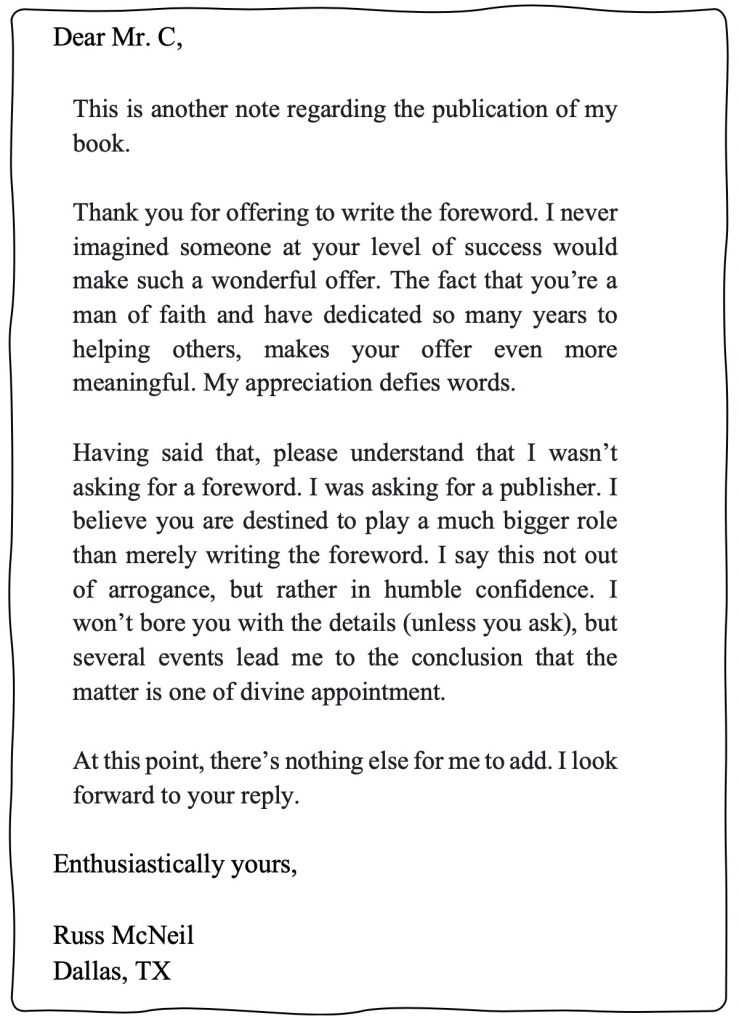
What a day! It’s not everyday someone you barely know says to you, “The Lord told me to tell you something …” There is no question in my mind as to the context of His message. The Lord is referring to my request of a certain publisher, the same publisher who has already declined once. I already have plans to send a second email asking Mr. C to reconsider the request. Too many things are lined up perfectly for him not to be my publisher. Now, with the divine word relayed by my coworker, Michelle, I’m more confident than ever. [Note: there are other “coincidences” leading up to this email, though not as dramatic as the one involving Michelle. I omit them here for the sake of brevity.]
My second email went like this:
Two days later, my phone rings.
“Hello, this is Russ.”
“Hi, Russ. My name is Brian. Mr. C asked me to give you a call.”
Chapter 8: This is how we do it
“Well, I appreciate you calling, Brian.”
“Mr. C wanted me to call and explain how we minimize the costs associated with publishing a book. The thought is that way you can do likewise and publish your own book. The number one thing we do to minimize costs is print large quantities.”
“What do you consider a ‘large quantity?’”
“We typically print 10,000 copies at a time.”
“Oh, wow. How much does that cost?”
“There are a number of factors, but an average size book in the personal development genre, at that quantity, typically only costs 70 to 80 cents per copy.”
“Well, Brian, here’s the deal: I have three kids in private school; my wife works only part-time; and we’re still recovering from an extended period of unemployment. Eighty cents a copy sounds pretty cheap, but 10,000 of them rolls up to 8,000 bucks. I know people need this book. It’s going to help a ton of folks. However, I’m not in a position to cut a check for eight grand for printing. Not to mention the space to store them.”
“I hear you, Russ. The thing is your book is practically ready for print. I’ve been involved in publishing for a long time. I do the ghost writing for Mr. C, and I’m constantly evaluating manuscripts. I have never seen a first-draft manuscript so close to being finalized. You’ve done a great job.
“. . . which gives me an idea,” he continues. “I won’t share it just yet because it’s way out of the box and I have to run it past Mr. C first. But, depending on his response, it could work out very well out for both of us.”
“Sounds, intriguing, Brian. When should I expect to hear something?”
“Give me a week.”
“No problem. Do you need anything else from me?”
“No. I’ll take it from here.”
Never in a million years would I ever guess what Brian has in mind. I settle in for seven days of wondering.
On day three, the wait is over
Chapter 9: Out of the box
I’m three days into what I expect to be a seven day wait. What kind of idea does Brian have up his sleeve? He said it’s ‘out of the box.”
Brian’s follow up comes in the form of an email:
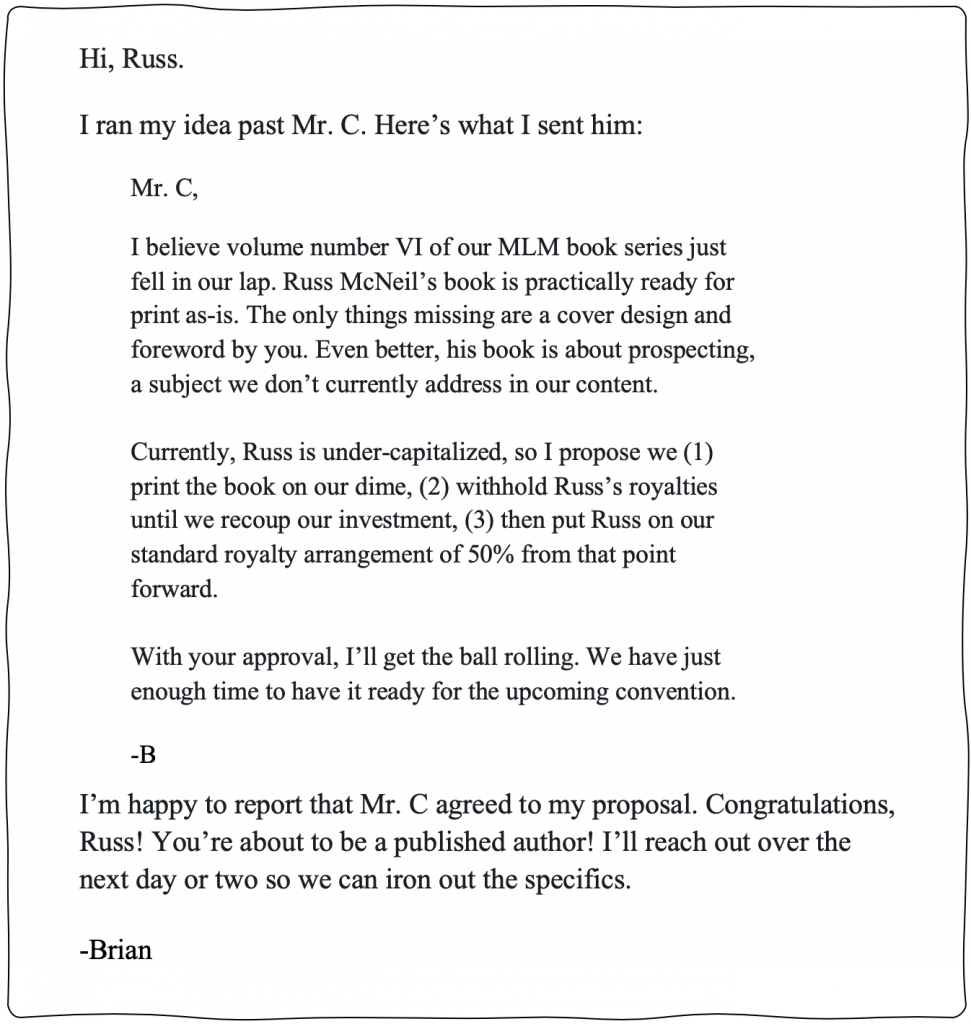
Needless to say, I’m excited. Brian told me his idea is “out of the box.” I don’t realize just how “out of the box” it is. Not until much later. The Lord said, “the answer is ‘yes,’” and is it ever! Fully published with zero out of my pocket. Furthermore, the publisher leaves my content as-is (no special mention of our particular company), and the publisher stakes no claim on the content. I’m free to do with it as I see fit. This last point is critical for the future (as you will read a bit later).
Brian’s idea does represent a risk for the publisher. I mean what if the book doesn’t sell? The convention is coming up, so it won’t be long before we find out.
Because of the Mr. C’s involvement in the MLM company of interest, his publishing company always has a large presence at the conventions; an enormous booth, with dozens of book titles. Mr. C is a prolific author within the personal development genre, and most of his titles are available at the conventions.
This time, there’s a new book in the mix: mine! Of the 10,000 copies printed, the publisher brings nearly 800 of them to the convention. I decide to stay at the publisher’s booth to promote my book.
Neither Brian nor I expect what happens next.
Chapter 10: Don’t walk—run!
We arrive at the convention center Thursday morning. The convention doesn’t officially start until Friday morning, but the leaders come in the day before so they can attend presentations designed for “their eyes only.”
One such leader, G, “just so happens” to saunter by the publisher’s table while we’re still setting up. He sees my book laying on the table, makes a quick purchase, and walks away. I don’t see any of this take place.
We man the booth Friday morning before the doors open. The first session starts at 10:00 am. Around 10:30 or so, we have a visitor. It’s G. As he approaches, I notice a copy of my book in his hand.
“What can you tell me about the author of this book?”
“Quite a bit, actually,” I reply, smirking. “I am the author. What would you like to know?”
“You wrote this?” he asks elevating my book to eye level.
“Well, that is my name on the cover. I had help though. There’s a lot of divine inspiration in there.”
“Yeah, I can tell. I’m a minister and I sense it between the lines.”
“I’m glad you noticed. Let me ask you something. Imagine if you weren’t a man of faith. Is there anything in there you would find offensive?”
“If I wasn’t a person of faith, I wouldn’t even notice. Like I said, it’s between the lines.”
“That’s good, because the primary goal of the book is to empower all readers no matter what they believe.”
“Oh, it does that,” he replies. “This book is exactly what people need. I bought it yesterday. I started reading it last night, and I could not put it down. I stayed up and read the whole thing. I’m so impressed, let me tell you what I did. I kicked off the first session this morning. While I was speaking, I held up your book, with the cover facing the audience, and said, ‘When it comes to prospecting, this is, by far, the best book out there. Run—don’t walk—to the book table and a get a copy today.”
“You actually said that from stage?” I can hardly believe what I’m hearing.
“I sure did. Meant every word too.”
Fifteen minutes later, the hordes rush our book tables. Thankfully, they’re unarmed.
Chapter 11: But, that’s not how we do it
One of the company’s leaders had just promoted my book from stage. A short time later, we have a massive rush at the publisher’s booth. People buy lots of different books, however, just about all of them include my book in their purchase. By that afternoon, we sell out; all except a couple of copies held back for display purposes.
The inventory goes down, but interest in the book does not. We start taking payments for backorders. We have plenty more copies, but people have to wait until we get back to the office to fulfil their orders. I don’t remember exactly how many copies we sell that weekend, but it’s more than enough to cover the initial print run. A few days, after we return, Brian runs the final tally, and calls to give me the news—I’m officially in “royalty territory.”
Two or three months after all this, I find out Brian is coming to Dallas. I reach out and invite him to join Tammy and I for an upscale Tex-Mex dinner. During the meal, I mention how exciting it is to recoup the initial outlay so quickly. I don’t realize it, but the conversation is about to take a very interesting turn.
“It sure is,” says Brian. “Funny thing about that…”
“What’s funny?”
“Well, when I learned we recouped our investment so soon, I told Mr. C about it. I said, ‘We sold enough copies of Russ’s book at the convention to recoup our entire investment. He’s already on the royalty plan.’”
“Mr. C, ask me, ‘What are you talking about, Brian?’”
“I said, ‘You know—the proposal I sent over and which you authorized: we pay for the printing and withhold Russ’s royalty until the cost of printing is recovered, then we start paying his royalty.”
“Mr. C gets a perplexed look on his face and says, ‘I agreed to that?’”
“Yes sir, you did.”
“’Well, if I agreed, I’m glad it worked out, but that’s not how we do things with our authors. Let’s not do that anymore.’”
Brian finishes relaying his story. I’m stunned. Mr. C is an extraordinarily successful businessman. He deals fairly and honestly, but what he doesn’t do is make deals without careful consideration. Why did he agree to Brian’s proposal if the terms weren’t to his liking? It’s not as if he needed the deal. I might have needed the deal, but Mr. C most assuredly did not. And yet he agreed to it anyway. Why?
Because the Lord arranged it. That’s why. Which is why, by this point in the conversation, I’m grinning ear to ear. God in Heaven keeps showing His interest in the project. I recognize a trend when I see one.
And this particular trend is one I find both gratifying and humbling.
Chapter 12: Goosebumps and dreams
A year goes by. The next convention comes around. I decide to work the book tables again. This time things are different because my book’s been out in the wild for a full year. I take up position on the customer side of the tables (not behind the table as do the publisher’s employees). This affords me the opportunity to mingle with potential customers.
Some of the people have read the book and some have not. My goal is to raise awareness of the book. Basically, I’m prospecting people about a book which is about prospecting. This means I have to engage people about a book with my name on the cover without coming off as self-serving or pretentious.
The environment is hectic with a steady stream of people. Some of them stop at our tables to look. Others scan the various titles visually as they slowly stroll past. Both represent “qualified” prospects. My strategy is straightforward. I simply walk up, gesture to a copy of my book laying on the table, and ask, “Have you read this one?” I make a point not to identify myself as the author.
The most common response
The response I get most often is, “No, I’ve not read that book. What’s it about?”
My standard answer is, “It explains how to approach people you don’t know with your business opportunity. It uses plain English to share real-world stuff that gets real-world results. It also happens to contain a lot of humor.” The conversation ensues from there and virtually everyone buys a copy, because after all, who doesn’t want to be a better prospector?
The most surprising response
I’ll never forget: I ask one woman, “Have you read this one?” I’m not prepared for her response.
She, points at my book and says, “You mean this one? This book right here?”
“Yeah, that one.” Remember: she does not know she’s talking to the author. She mistakenly thinks I’m a potential customer asking for her input.
“Let me tell you about this book.” she states boldly, “This book changed my life!!”
She says it so emphatically and with so much conviction, I have to know more. So, I say, “Well, as the author I would love to know why you say that. Hi, my name is Russ. Russ McNeil. Please—tell me more.”
“You’re the one who wrote this?”
“Yes, ma’am. Sounds like it made quite an impact.”
“This book is exactly what I needed. I read it and started to do what is says, word-for-word. Thirty days later, I had personally sponsored 100 new associates. Like I said, ‘It changed my life.’”
Turns out, she’s been involved in personal development for years. Consequently, she had a lot of pieces already in place. What she didn’t have is the words to say. My book gave those to her. I’ve had other people send emails with containing the phrase “changed my life,” but the instance described above was the first. And the most dramatic.
The most rewarding responses
Quite a few people read the book during the first year. It’s an honor to meet and talk with some of them. The most rewarding responses come from these readers.
“Have you read this one,” I ask.
“Oh, yeah. That’s a great book.” (A very common response; not self-glorification.)
“So, you found it helpful?”
“Definitely.”
I offer a handshake and say, “Hi, my name is Russ. Russ McNeil.” I realize most people aren’t going to recognize my name as the author, so I follow up immediately with, “They put my name on the cover.” I word it like this because, again, I don’t want to come off as pretentious. Besides, it introduces a bit of levity, which in this scenario can only help.
“Oh, wow. You wrote this book . . .”
“I did. Tell me, if you will, what parts of the book did you find most helpful?”
Invariably, they respond with specific details. They don’t have to fish around or make up something out of politeness. The sincerity of their responses tells me the book really did help them. A number of times, I offer to expound on the concept they mention. I can’t tell you how many times I flow right into training mode right there in the aisle between tables. Passers-by begin to gather ‘round to take in the free practical advice. One even said, “This is the kind of stuff I came to the convention for. Who knew I’d have to come to the book tables to get it!”
Goosebumps
I have to keep the spontaneous training sessions short because my primary responsibility is to work the tables. I bring the mini-sessions to a close by saying, “I apologize guys. In case you can’t tell, I’m a tiny bit passionate about the subject. Sometimes, I don’t know when to shut up. I’m gonna have to break this off. I tell you what though: I have goosebumps all over right now.” More than once, someone in the “audience” would rub their arms and say, “Yeah, me too.”
Dreams
A month or so after the convention, I meet with a good friend of mine, Aaron. He’s read the book, and he has MLM experience, but he isn’t active at the time of this particular conversation. I describe my experiences at the convention, including the spontaneous training sessions and the goosebumps.
“I can see that,” says Aaron, “Only those weren’t goosebumps.”
“Oh, yes they were.”
“Nope. Those were Holy Ghost bumps. You see, Russ, the Lord called you to teach others what you know about prospecting. When you broke out into those ‘spontaneous training sessions,’ as you called them, you were operating under the anointing of the Lord. You were literally fulfilling your purpose. Those ‘goosebumps’ were an indication of the anointing. That’s why I call them ‘Holy Ghost bumps.’”
[Note: I still haven’t explained why the Lord is interested in the book project. I’ll get to that eventually. At the time of my conversation Aaron already knows. Thus, his comments make perfect sense to he and I both.]
“Furthermore,” says Aaron, “I tell you something else. I had a dream about your book and your training sessions.”
“You did?”
“Sure did,” replies Aaron. “Sometimes God shows me things in dreams.”
“And the Lord showed you something about my book?”
“Yeah,” confirms Aaron. “He showed me that when we’re all in Heaven, you’re going to be very surprised at how happy Jesus is about the work you’re doing.” Aaron goes on to explain why. The conversation affirms the calling I feel on my life.
Chapter 13: Stepping out
Despite the positive reception of my first book, it’s time to move on. Due to Mr. C’s close ties to a specific MLM company, the cover of my first book is branded for that company. Here’s the thing, though: my content is 100% generic. The principles and strategies I teach are based on human nature. As such, they apply across the board, regardless of the company. The time has come to publish an unbranded edition of the book.
I end up with a referral to Mr. H. He is a well known publisher of books written for the MLM profession. Most of the books he publishes are written by big names in the industry. Mr. H asks for an evaluation copy of my book. He reads it. He likes it. He wants to publish it.
“However,” he says, “you’re going to need a new title and a new cover,”
“What should I call it?”
“Something catchy. How about ‘Prospecting Rules!’?”
I recognize the play on words immediately. “I like it! ‘Prospecting Rules!’ it is.
“Now, about the cover . . .” says H. “I’m going to refer you to a guy. He’s an artist and a genius at both cover design and branding. His name is J.”
By this point in the project, I’m getting excited all over again. An unbranded book will make a viable offering to the entire industry, without being limited to a single company. I call J immediately.
J asks me to describe the book, which I do. His response is immediate: “Well, based on your description, Russ, here’s what comes to mind . . .”
Mr. H was right; J is a genius. He captures the book’s personality immediately and perfectly.
“How much do I need to budget for a cover like that?”
“Well,” says, J. “I don’t normally do standalone covers. I normally create an entire package; brand, logo, website, and cover, all together. A package like that starts at $15K.”
“Well, J, here’s the deal. I realize that Mr. H is used to dealing with top earners in the MLM industry. Most of them are pulling in 50-100K a month or even more. Fifteen-grand for them is nothing. Thing is, I’m not in that category. Not even close. I’m sure your package is worth every penny. Unfortunately, It’s simply not within my reach.”
“I understand, Russ. Tell you what, Russ: I really like the concept behind your book. And when you talk about it, your passion comes through loud and clear. It’s the kind of project I’d like to be part of. To that end, tell you what I’ll do, if you let me retain the copyright, I’ll do a standalone cover for 10% of the package price. Call it $1,500 even.”
I can’t agree fast enough.
Mr. H and I never do agree on the terms of a publishing deal, so I decide to self-publish the book. Nevertheless, the title Prospecting Rules! stands. And J’s design still covers the book today.
I thank the Lord for arranging the cover deal with J. I still think about that and I’m still every bit as grateful, but I can’t say I’m surprised. I understand the Lord’s interest in the project. Of course, He’s going to support it.
Chapter 14: Enter the critters
Sometime after the release of Prospecting Rules!, I say to Tammy, “I think I’m going to write another book.”
“What’s this one about?” she asks.
“It’s an idea that’s been percolating for a while. I’m, gonna take a handful of animals on the ark—say eight or nine of ‘em—and use ‘em as illustrations for prospecting lessons.”
“You mean Noah’s ark?”
“Yeah. I’ll write a short e-book, make it fun and informative, and sell it for 99¢. The idea is to use it to promote Prospecting Rules. I’m going to call this one Lessons from the Ark.”
And this is exactly what I set out to do.
I make a short list of critters and start writing. There isn’t much research required because I grew up surrounded by books, and a lot of them were about nature and the animal kingdom. The prospecting lessons too are off the top of my head. For these reasons, the writing comes together rapidly.
After three or four lessons, other critters with lessons come to mind. I add them to the list. The next day, I add a few more. This goes on for several days. I tell Tammy, “This ‘little’ book is turning into a bigger project than I thought. The Holy Spirit is taking it over.”
The list of animal lessons in my mind gets longer everyday. Literally. I have the growing sense that the final number is going to be 40. Thirty, thirty-six, thirty-eight, and then forty. Sure enough, when the list hits forty, I “know” in my spirit it’s complete. A few other lessons come to mind, but oddly, I don’t feel led to include them. (Note: the appendix of Ark explains the biblical significance of the number 40 and how it relates to the book.)
The entire project—manuscript, custom illustrations, layout, and cover—is complete in six weeks flat. And there it sits for a year and a month. I won’t bore you with the reasons I set it aside, but after thirteen months, I finally send it to the printer and start immediately on yet another book project.
Only this one isn’t the Lord’s idea at all. I just don’t know it yet.
Then, Ark arrives from the printer.
And that’s when it happened.
Chapter 15: Critters, critters, everywhere
I’m working on an “unsanctioned” manuscript when Lessons from the Ark arrives from the printer. A couple of days after that, it happens. I’m walking from the living room to the master bath, when the Lord gives me new direction. It’s not like I hear Him like I did in chapter 5. It’s more like a thought. But this isn’t just any ol’ random thought. This is the spark of an idea, a marvelous idea, and it begins to unfurl into an even bigger idea. In the span of mere seconds, it’s clear as day.
And it most certainly didn’t originate with me. Not a chance. I feel energized by the excitement. Turns out Lessons from the Ark is not a mere promotional piece. It isn’t a standalone critter book either. Lessons from the Ark is only the first in a series of four, the others being Lessons from the Zoo, Lessons from the Sea, and Lessons from the Sky.
The idea isn’t merely the addition of three separate titles. He also gives me a creative plot that ties all the critter volumes into a cohesive series. The plot even includes Ark. There is no way I would have come up with the plot on my own.
40? again?
I question whether the animal kingdom offers enough lessons to fill another three books. Oh, I’m sure I can find a few here and there, but Ark set the standard of that special number 40. Could there really be forty more lessons from zoo animals, another forty from marine life, and yet forty more from birds? Only one way to find out—do some research.
Initial online searches look promising, so I order several wildlife reference books, one of which ends up being a jackpot of ideas. Encouraged, I order more reference materials. And more. And more. And more. (Today, just the wildlife portion of my library contains several tens of thousands of pages.)
My first step is to make a list of “candidates”—animals illustrating worthwhile lessons. Many are duplicates, but duplicate or not, every single one goes on the list. I’ll sift the list later, after I survey the full range of potential lessons.
More than enough
Even after culling duplicates and refining the list, the number of lessons exceeds forty per title. Turns out forty has not only biblical significance, it also happens to be just about right for a 160-page book, which in turn, is the optimum page count for books within the personal development genre. It’s all too perfect. You can’t plan this kind of stuff.
With purpose(s)
As I begin writing the manuscript for Zoo, the Lord reveals more about the project. Apparently, He has multiple purposes behind the books. His first purpose is to impart wholesome know-how regarding human connection skills. Such skills bring genuine value—business and otherwise—into the lives of others. The second purpose of the critter books is to celebrate the majesty of God’s infinite creativity as manifested in the animal kingdom. Animals represent an awe-inspiring array of abilities, behaviors, and traits. By highlighting these characteristics of creation, the critter books reflect glory to the Creator.
As Zoo begins taking shape and I start to get a feel for the rhythm of the new critter books, I realize there are a ton of animals with fantastic lessons that simply are not going to fit within the confines of four volumes (Ark, Zoo, Sea, and Sky). What am I to do? Is there not a way to share the overflow lessons too?
Eventually, the Lord shows me what to do with the overflow lessons: give them away! This is how More Critters, More Lessons came about. More contains—you guessed it—40 profoundly powerful lessons that wouldn’t fit in the first four volumes. And the best part? It’s available at no charge (details here).
But wait, that’s not all!
Through the course of researching for the first five volumes of the critter series, I uncover a number of animals each representing multiple lessons. The giraffe, for example, illustrates fourteen lessons all by itself; fourteen lessons team builders need to know! Each of these critters warrants a dedicated volume. I refer to these titles as “Species Spotlights.”
The more I write, the more content He shows me. I jokingly say I’ll have to take my laptop to Heaven in order to get it all done. All joking aside, it—the content, that is—just won’t quit. He just keeps pouring it in. Sometimes, I feel like I’m drinking from a fire hydrant; it ain’t easy, but one thing’s for sure: ya ain’t about t’ go thirsty!
Lessons from the Giraffe is available today. Four parrot titles are in process now (three are done, but on hold until the fourth is complete). Plans for future titles of Species Spotlights include whale, octopus, albatross, chameleon, butterfly, shark, penguin, bee, crocodile, and crow.
And now you know
And know you know the “God stories” behind the books. The one thing I haven’t shared is why Yahweh has such a keen interest in them. I did share that one purpose behind the books is to reflect glory to Him by celebrating the majesty of His animal creations. There is, however, an even more compelling Kingdom purpose I didn’t spell out directly.
And I’m not going to.
The question
Instead, I pose it as a question to you. Why would the Creator of the universe, the Only True and Living God, take an interest in books focused on teaching people how to prospect for, of all things, network marketing? Silly question, you say? Preposterous, you think? No, no, my friend. Nothing silly or preposterous about it.
The question and the answer are both as real as it gets. So, let me ask again: Why would the Creator of the universe, take an interest in books that teach people how to prospect for network marketing?
Email the correct answer, and I’ll give you 30 minutes of personal prospecting coaching via Skype. No strings attached. No obligation of any kind. Just my complementary gift to you.
Now, go knock ‘em alive.
-Russ
Forever.